Number chart (1–20)
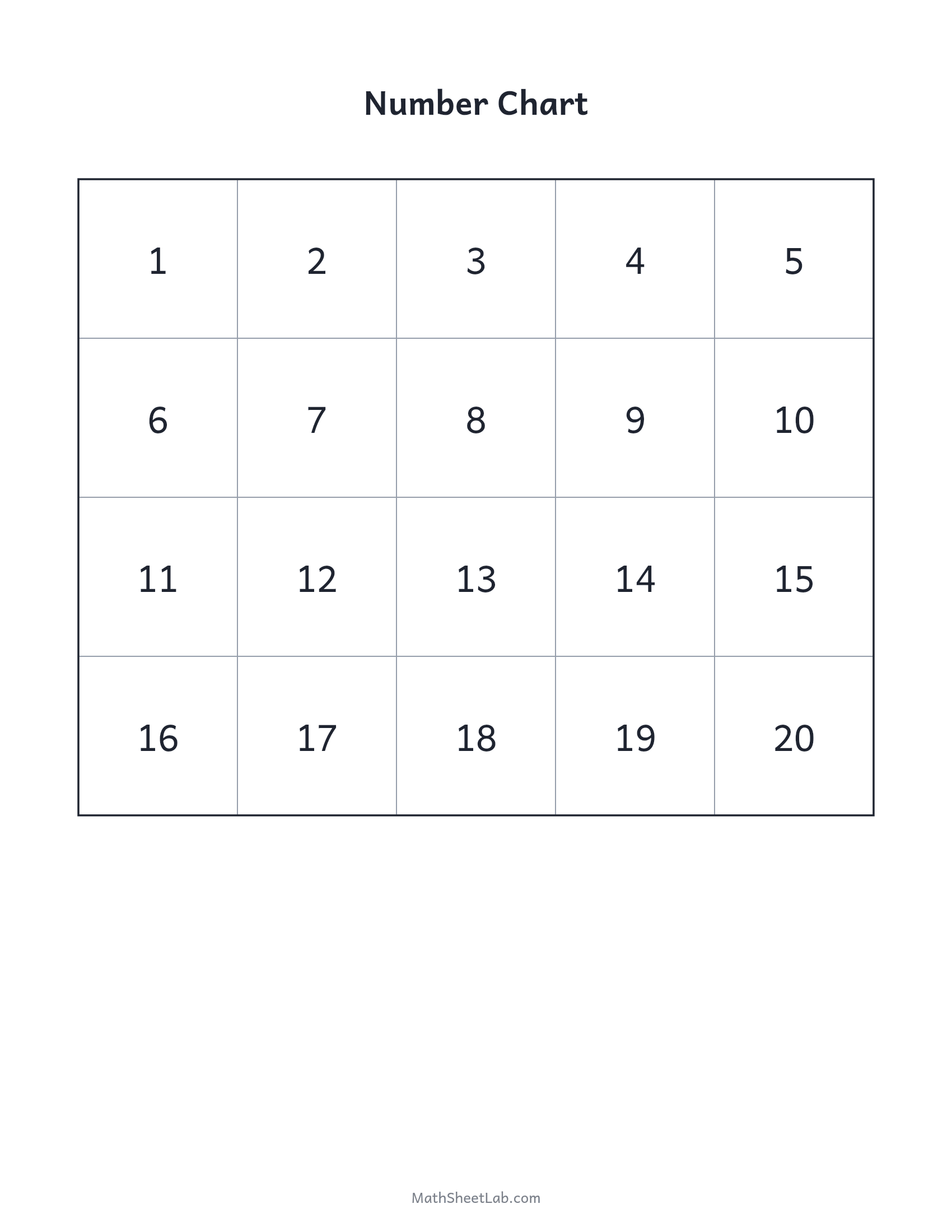
Numbers 1–20 with big, friendly cells — the first number chart, sized for the youngest learners.
How to print it
- Open the print view. Press Print for a clean print-ready view, or download the PDF or PNG below the chart.
- Fit to page. In the print dialog choose “Fit to page” — the chart is laid out for US Letter and scales cleanly onto A4.
- Copy freely. Print or photocopy as many as you need for home, classroom or tutoring use. It is free, with no sign-up.
About the number chart
Before the hundreds chart makes sense, children need the numbers to 20 to be automatic — recognising them, naming them, and seeing that 13 is a ten and three more. This chart keeps the count small and the cells big: five numbers per row, so each step down a column adds five, mirroring the way children count on fingers and ten-frames — five and some more. The large, clear numerals also give beginning writers a proper model to copy when they practise forming numbers.
Frequently asked questions
What age is a 1–20 number chart for?
Pre-K, kindergarten and early 1st grade — whenever number recognition and counting to 20 are the focus.
Why five columns instead of ten?
Bigger cells and a friendlier count for little learners, and rows of five mirror fingers and ten-frames — five and some more.
What comes after this chart?
The hundreds chart (1–100), and then the 120 chart used in 1st grade.