Multiplication chart
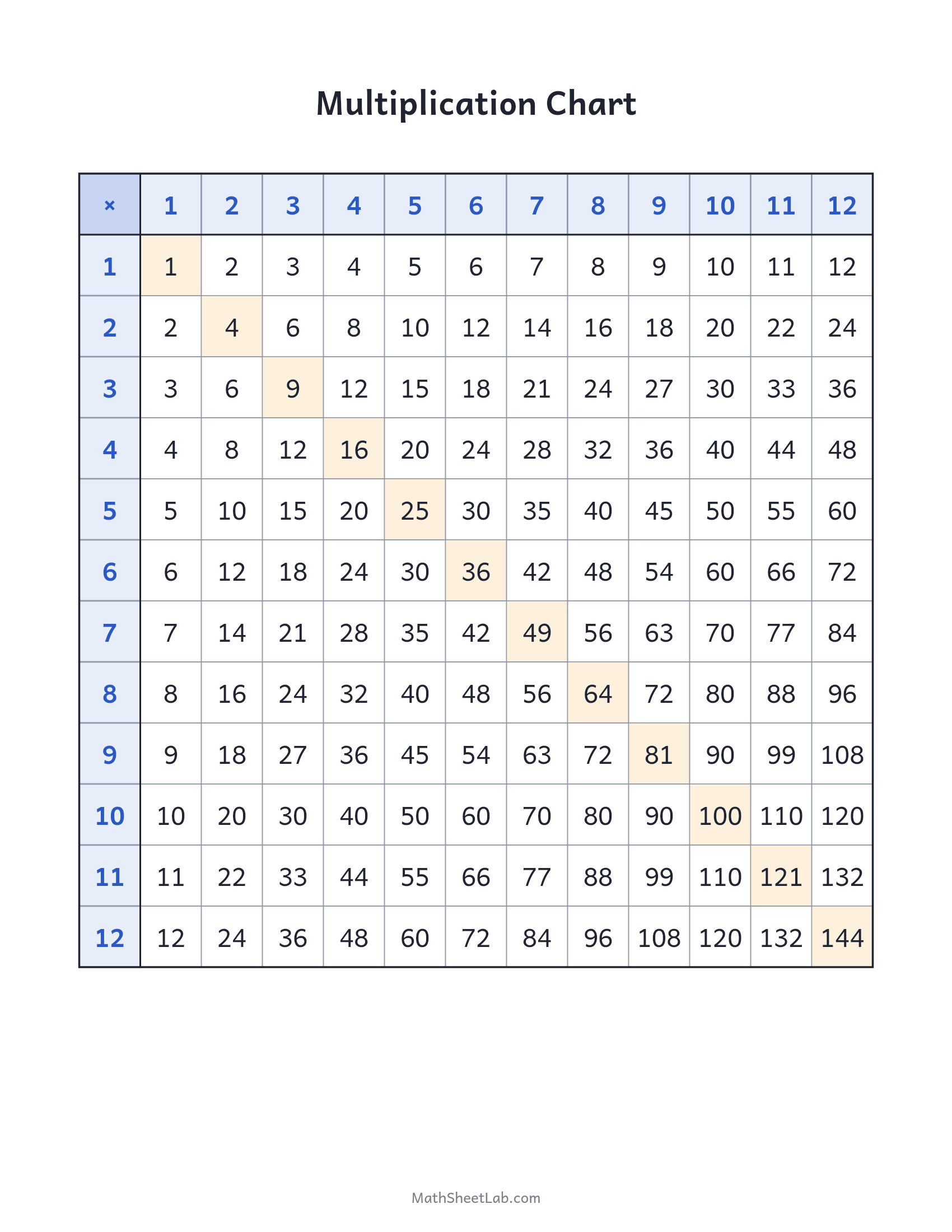
The times tables from 1×1 to 12×12 in one grid — explore it below, then print it, download the PDF, or grab any other size: 1–15,1–20, 30×30,blank orblack & white.
Try it: hover any cell
| × | 1 | 2 | 3 | 4 | 5 | 6 | 7 | 8 | 9 | 10 | 11 | 12 |
|---|---|---|---|---|---|---|---|---|---|---|---|---|
| 1 | 1 | 2 | 3 | 4 | 5 | 6 | 7 | 8 | 9 | 10 | 11 | 12 |
| 2 | 2 | 4 | 6 | 8 | 10 | 12 | 14 | 16 | 18 | 20 | 22 | 24 |
| 3 | 3 | 6 | 9 | 12 | 15 | 18 | 21 | 24 | 27 | 30 | 33 | 36 |
| 4 | 4 | 8 | 12 | 16 | 20 | 24 | 28 | 32 | 36 | 40 | 44 | 48 |
| 5 | 5 | 10 | 15 | 20 | 25 | 30 | 35 | 40 | 45 | 50 | 55 | 60 |
| 6 | 6 | 12 | 18 | 24 | 30 | 36 | 42 | 48 | 54 | 60 | 66 | 72 |
| 7 | 7 | 14 | 21 | 28 | 35 | 42 | 49 | 56 | 63 | 70 | 77 | 84 |
| 8 | 8 | 16 | 24 | 32 | 40 | 48 | 56 | 64 | 72 | 80 | 88 | 96 |
| 9 | 9 | 18 | 27 | 36 | 45 | 54 | 63 | 72 | 81 | 90 | 99 | 108 |
| 10 | 10 | 20 | 30 | 40 | 50 | 60 | 70 | 80 | 90 | 100 | 110 | 120 |
| 11 | 11 | 22 | 33 | 44 | 55 | 66 | 77 | 88 | 99 | 110 | 121 | 132 |
| 12 | 12 | 24 | 36 | 48 | 60 | 72 | 84 | 96 | 108 | 120 | 132 | 144 |
Print the multiplication chart
Every size and style
How to use it (and stop needing it)
- Pick your chart. The classic 1–12 chart is below; larger grids (1–15, 1–20, 30×30), a blank fill-in version and an ink-friendly black-and-white version are one click away.
- Print or download. Press Print for a clean print view, or download the PDF or PNG. Choose “Fit to page” — it is sized for US Letter and scales to A4.
- Learn the facts. Use the chart for lookup, the written-out tables for reciting, and the blank chart to test recall — the guides walk through the routine.
Two patterns do most of the teaching. The shaded diagonal holds the square numbers(1, 4, 9 … 144), and the grid mirrors itself across it — 3×8 and 8×3 are the same cell twice, so half the chart is free. And every row is skip counting: row 5 reads 5, 10, 15, 20 — the fives count a child already knows. When you’re ready to move from looking up facts to memorising them, print the blank chart and readhow to teach multiplication facts.
Multiplication chart — FAQ
How do you read a multiplication chart?
Find the first factor in the left column and the second in the top row; the product is where the row and column meet. For 7×8, row 7 meets column 8 at 56.
What size multiplication chart should I print?
For learning the facts, the 1–12 chart is the standard. Print 1–15 or 1–20 for older students, the 30×30 as a reference poster, and the blank chart for fill-in fluency practice.
Why is the diagonal shaded?
Those are the square numbers — 1, 4, 9 up to 144. The chart mirrors itself across that diagonal (3×8 = 8×3), which halves what a child has to memorise.
Is the multiplication chart free to print?
Yes. Print it, download the PDF or PNG, and photocopy as many as you like for home or classroom use. No account, no watermarks.
Can I fill the chart in online?
The grid at the top of this page is interactive — hover or tap any cell to highlight its row, column and product. For write-in practice, print the blank multiplication chart.