Place value, explained simply
Updated 2026-07-08 · MathSheetLab guides
Where a digit sits is what it’s worth
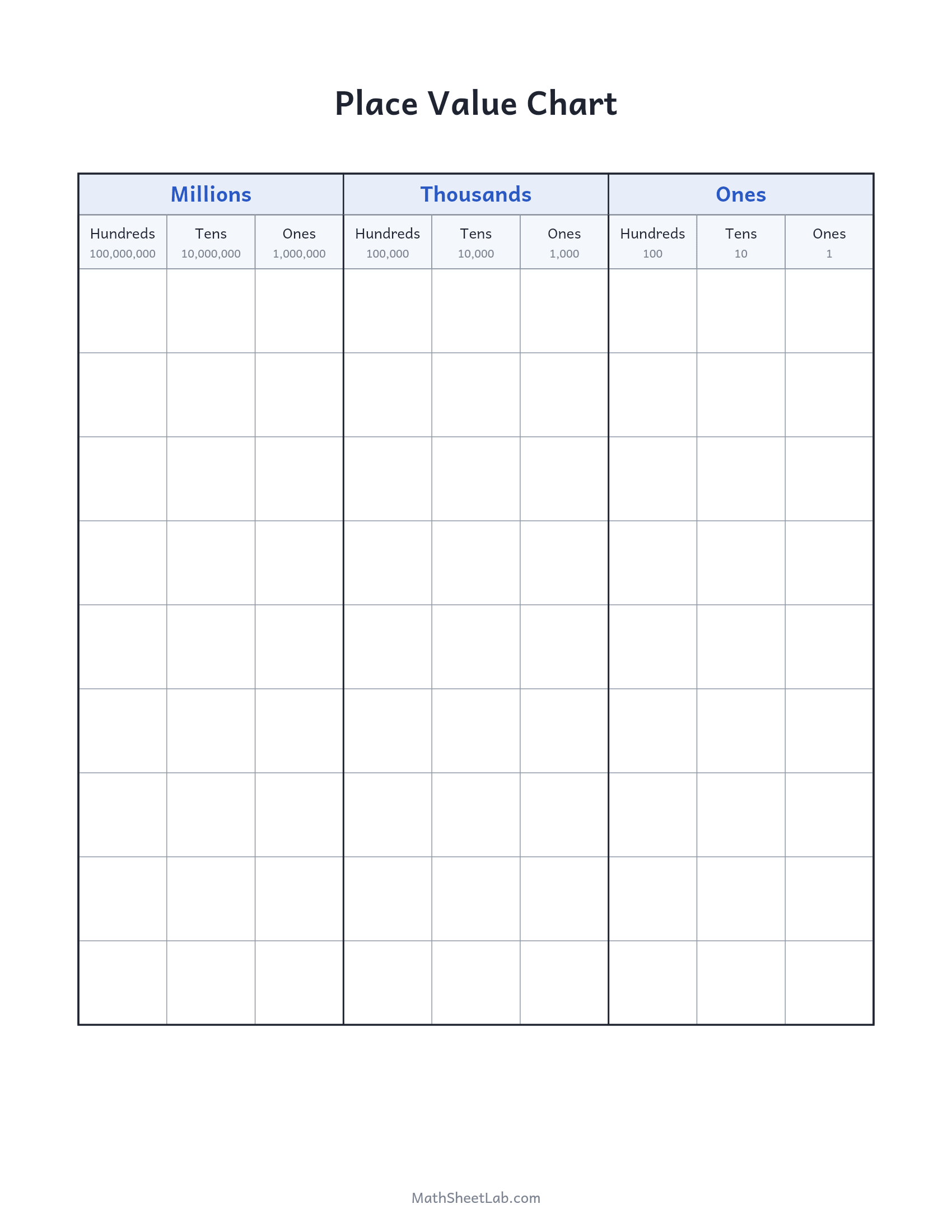
Place value is the rule that makes ten digits enough to write any number: each column is worth ten times the column to its right. The 4 in 47 is forty; the 4 in 470 is four hundred. Children who miss this idea aren’t bad at math — they’re treating 47 as a picture instead of a sum of parts (40 + 7). The place value chart exists to force the parts apart.
Periods: how big numbers stay readable
We group digits in threes — ones, thousands, millions — and each group (a "period") repeats the same hundreds-tens-ones pattern. That’s why 4,203,000 is readable at all: four million, two hundred three thousand. Reading a big number is just reading three-digit numbers with surnames attached.
The zero problem
Every teacher knows the error: asked to write "three hundred four thousand, twenty", a child writes 34,20 or 300,400,20. Zeros are placeholders, and holding a place you can’t hear is genuinely hard. The chart fixes this mechanically: one digit per column, and the empty columns must be filled with zeros. Dictating awkward, zero-heavy numbers onto the chart is the single best place-value exercise there is.
A five-minute routine
Dictate three numbers onto the chart (make at least one zero-heavy). Then reverse it: write digits into the chart and have the child read the number aloud, period by period. Finish with "make it ten times bigger" — slide every digit one column left and watch the value shift without changing a single digit.